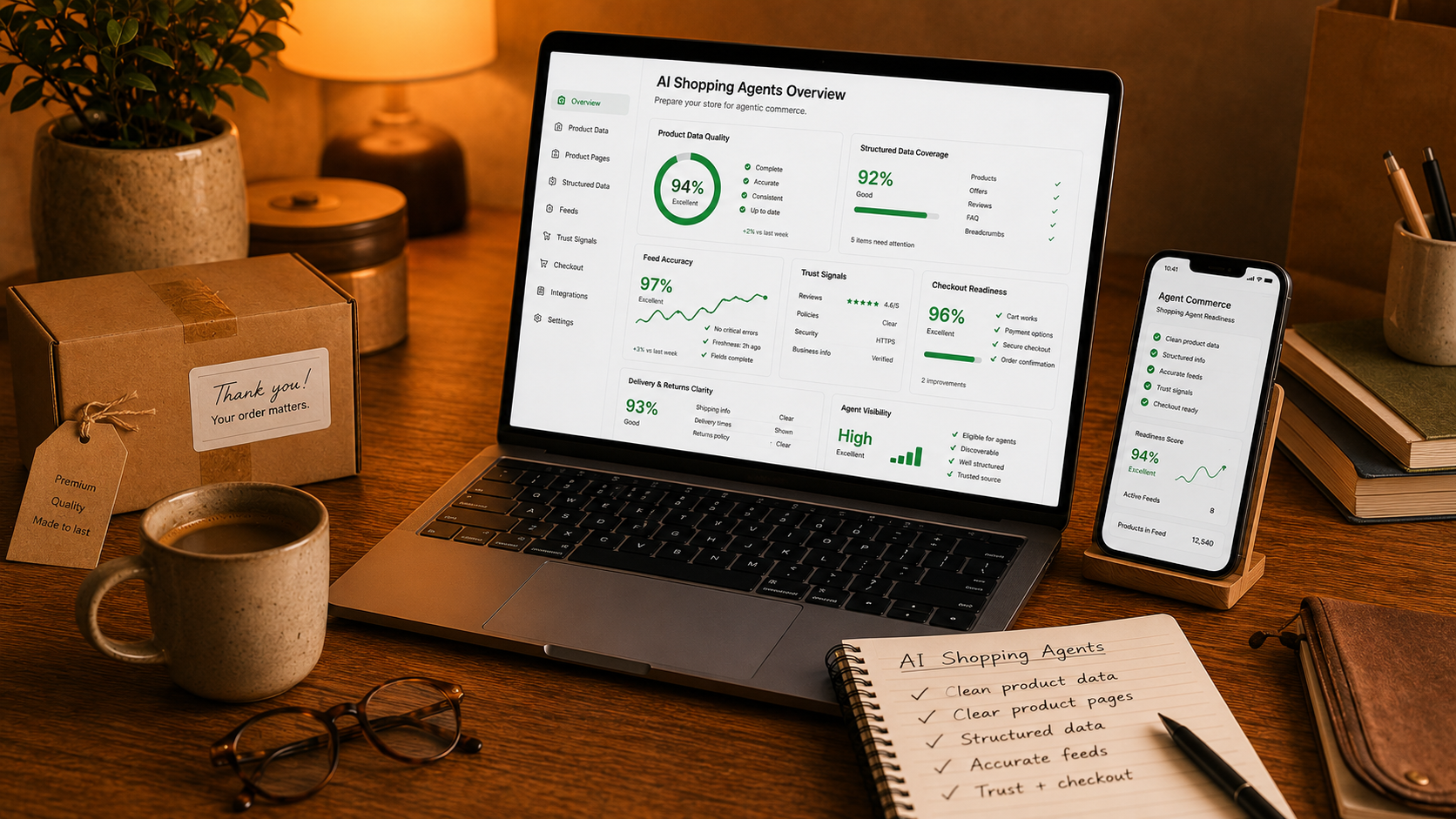

AI shopping agents are starting to change how customers find products online.
A customer may no longer search only by typing keywords into Google or browsing a category page. They may ask an AI assistant to compare products, check prices, review delivery options, and recommend the best choice.
For online stores, this creates a new challenge.
Your website must be clear for people, but it also needs to be easy for machines to understand.
Agentic commerce is not just about AI hype. It is about making product data, store information, checkout rules, and trust signals easier to read, compare, and use.
Why AI Shopping Agents Matter
AI shopping agents can influence the buying journey before the customer reaches your store.
They can help customers:
• Discover products
• Compare options
• Check prices
• Review delivery rules
• Understand product differences
• Choose between brands
• Move closer to checkout
If your product data is unclear, incomplete, or inconsistent, your store may be harder to recommend.
That does not mean every store needs a full AI strategy today.
But it does mean stores should start fixing the basics.
Clean product data, clear policies, structured information, and reliable feeds will become more important.
Start With Product Data
Product data is the foundation of agentic commerce.
AI tools need clear information to understand what you sell and why it matters.
Important product data includes:
• Product name
• Product description
• Product category
• Price
• Stock status
• Product images
• Product variants
• Size
• Color
• Material
• Brand
• SKU
• GTIN or other identifiers
• Compatibility information
• Delivery information
If this information is missing or messy, the product becomes harder to understand.
A human customer may guess what a product page means. An AI assistant may not.
Make Product Pages Clear
Good product pages help both customers and AI systems.
A product page should answer the customer’s main questions without making them search.
Customers should quickly understand:
• What the product is
• Who it is for
• What problem it solves
• What is included
• What options are available
• How much it costs
• When it can be delivered
• How returns work
Do not hide important details inside images only.
Text content matters because it can be read, indexed, structured, and reused across channels.
Use Structured Data
Structured data helps platforms understand your store more reliably.
It gives search engines, shopping platforms, marketplaces, and AI systems clearer information about your products.
Useful structured data can include:
• Product schema
• Price
• Availability
• Reviews
• Brand
• SKU
• Images
• Breadcrumbs
• Organization information
• FAQ content
Structured data will not fix a weak store by itself.
But it helps strong content become easier to understand.
Keep Feeds Accurate
Product feeds are becoming more important.
Your store may already send product information to Google, Meta, marketplaces, email tools, comparison platforms, or other sales channels.
AI shopping journeys will depend on the same type of clean data.
Common feed problems include:
• Wrong prices
• Missing products
• Old stock data
• Broken image links
• Missing variants
• Poor product titles
• Inconsistent categories
• Wrong URLs
• Rejected products
These problems can hurt visibility before the customer even visits the website.
If the feed says one thing and the website says another, trust drops quickly.
Build Strong Trust Signals
AI can help customers compare stores faster.
That means trust signals need to be easy to find.
Customers want to know:
• Is this store real?
• Can I trust the payment process?
• How long will delivery take?
• What happens if I return the product?
• Are reviews available?
• Is support easy to contact?
• Are prices and stock accurate?
Trust should not be hidden in small footer links.
Important information should be visible across product pages, cart, checkout, and policy pages.
Improve Checkout Readiness
AI shopping agents may help customers get closer to purchase, but checkout still needs to work well.
If the customer reaches checkout and finds confusion, the sale can still be lost.
Check for:
• Clear order summary
• Guest checkout
• Fast payment loading
• Accurate shipping methods
• Clear delivery information
• Mobile-friendly forms
• Trusted payment options
• Helpful error messages
• No surprise costs
AI discovery can bring better traffic.
But conversion still depends on the store experience.
What Magento Stores Should Check
Magento and Adobe Commerce stores often have complex catalogs, custom attributes, product types, prices, and customer groups.
This flexibility is powerful, but it can also create data problems.
Magento stores should review:
• Attribute structure
• Product titles
• Category logic
• Configurable product data
• Feed rules
• Schema markup
• Stock sync
• Price sync
• Checkout rules
• Third-party integrations
The goal is not to add AI features randomly.
The goal is to make the store cleaner, faster, and easier to understand.
Final Thought
AI shopping agents will not replace every customer journey overnight.
But discovery is already changing.
Stores with clean product data, clear policies, reliable feeds, and strong checkout experiences will be better prepared.
Agentic commerce is not only about AI.
It is about removing confusion from the buying journey.
When your store is easier to understand, it becomes easier to recommend, easier to trust, and easier to buy from.

Let’s create your success story next.
We are happy to answer any questions you may have in regard to our eCommerce services!